
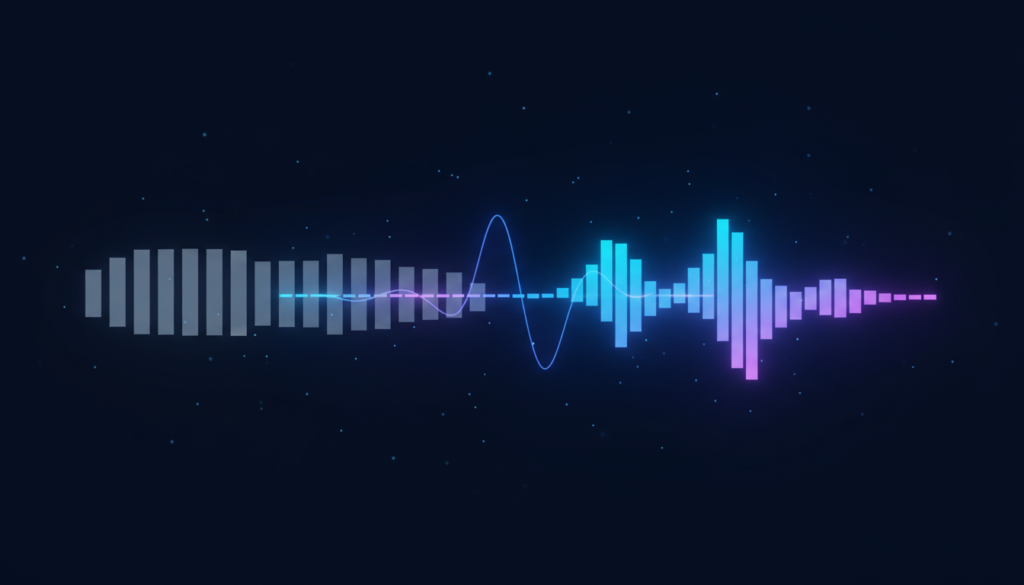
Quick answer: Perplexity measures how predictable each next word is to a language model; very predictable text has low perplexity. Burstiness measures how much a text varies, especially in sentence length. AI text tends to be predictable and even, human text more surprising and uneven. In our test, sentence-length variation in AI paragraphs was 0.18–0.27, while human texts ranged from 0.24 to 0.95.
If you’ve read anything about AI detection, you’ve probably seen two strange words: perplexity and burstiness. They sound technical, but the ideas are simple, and understanding them can make you a better writer whether or not you ever use an AI tool.
What is perplexity?
Perplexity measures how predictable a piece of text is to a language model. Imagine the model reading your sentence one word at a time and guessing what comes next.
- If the model guesses correctly most of the time, the text has low perplexity. It’s predictable.
- If the model is often surprised, the text has high perplexity. It’s less predictable.
Low perplexity example: “The sun rises in the east and sets in the west.” Every word is exactly what you’d expect.
Higher perplexity example: “The sun crawled over the rooftops like it was late for a meeting it didn’t want to attend.” The comparison is unexpected.
Language models generate text by choosing likely words, so their output often has low perplexity. Researchers have built detectors on this idea. One well-known approach, DetectGPT, checks whether a passage sits at a point the model itself finds especially likely, compared with slightly reworded versions (Mitchell et al., ICML 2023).
What is burstiness?
Burstiness measures variation across a text, especially in sentence length and structure.
Human writing tends to be “bursty.” We write a long, detailed sentence, then a short one. Then a question. Then a fragment, maybe. Our rhythm rises and falls. AI writing tends to be more even, which gives it a smooth but monotonous feel.
How different are human and AI texts? Our test
One simple way to measure burstiness is the coefficient of variation of sentence length: the standard deviation of sentence lengths divided by the average. Zero means every sentence is the same length; higher numbers mean more variety. Our AI Detector uses a version of this for its “Sentence rhythm” signal.
In November 2026 we measured it on 13 texts: seven human (four Wikipedia introductions from May 2021 and three public-domain story openings) and six short paragraphs generated by an AI model.
| Text type | Sentence-length variation |
|---|---|
| AI-generated paragraphs (6) | 0.18 to 0.27 |
| Wikipedia introductions (4, human) | 0.24 to 0.53 |
| Classic fiction openings (3, human) | 0.72 to 0.95 |
Every AI paragraph was at the low end. Fiction was the most varied by far. Formal encyclopedia writing sat in between, and one Wikipedia text (0.24) overlapped with the AI range. That overlap is exactly why burstiness alone can’t prove anything.
A side-by-side example
We wrote two paragraphs about email marketing and ran both through our detector.
Even rhythm (sentence lengths 9, 8, 10, 8, 9, 8 words):
“Email marketing is an effective strategy for small businesses. It allows companies to reach their customers directly. It can also help to improve long-term brand loyalty. Many companies use it successfully every single week. It is also cheaper than most other marketing channels. It gives businesses full control over their message.”
Varied rhythm (sentence lengths 3, 27, 1, 11, 2, 14 words):
“Email still works. In fact, for many small businesses, a simple weekly newsletter brings in more sales than every social channel combined, and it costs a fraction of the price. Why? Because the people on your list asked to hear from you. That’s rare. Most ads interrupt people who never wanted them, so you’re paying to be ignored.”
| Version | Variation | Human-likeness score |
|---|---|---|
| Even rhythm | 0.09 | 44% |
| Varied rhythm | 0.94 | 99% |
Both paragraphs were written to make the same point. The second also adds a specific claim, a question and an opinion, which is what real variety usually looks like.
How do detectors use these signals?
Many detectors combine predictability, variation and other features in a statistical model. Text that is both very predictable and very uniform scores as more likely to be AI. Text that is less predictable and more varied scores as more likely to be human. Many commercial detectors also use trained classifiers that combine dozens of features.
Why aren’t these signals perfect?
- Simple, clear human writing can have low perplexity. Instructions and beginner-level explanations are predictable by design.
- Non-native English writers often use common words and regular structures. A Stanford study found seven popular detectors flagged, on average, 61% of TOEFL essays by non-native writers as AI-generated (Liang et al., 2023).
- AI can be prompted to vary its style, increasing burstiness.
- Short texts don’t give enough data for reliable measurement.
That’s why detection results should always be treated as estimates. Our article are AI detectors accurate? covers the research in more detail.
How can you use these ideas to write better?
Add some surprise (healthy perplexity):
- Use a fresh comparison instead of a cliché.
- Include a specific detail the reader wouldn’t expect.
- Share an opinion or a counterintuitive point.
Vary your rhythm (healthy burstiness):
- Follow a long sentence with a short one.
- Use an occasional question.
- Mix paragraph lengths, with a one-line paragraph for emphasis.
- Start sentences in different ways.
Don’t overdo it. Clarity always comes first. Our guide to sentence length variety shows how to vary rhythm without making text harder to read.
Frequently asked questions
Is low perplexity bad writing?
Not at all. Clear, simple writing is often predictable. It only becomes a problem when the whole text feels generic.
Can I measure my own burstiness?
Roughly, yes. Count the words in each sentence of a paragraph. If most are within a few words of each other, try varying them. Our AI Detector shows a “Sentence rhythm” bar that does this for you.
Do all AI detectors use perplexity and burstiness?
Many use them or similar features, but modern detectors also rely on trained classifiers that combine many signals.
Does a humanizer change perplexity and burstiness?
Partly. Our AI Humanizer replaces stock phrases and, in Deep mode, splits very long sentences. Your own specific details and opinions are still the most reliable source of genuine variety.